Is a Mother-of-Pearl Spoon Dishwasher-Safe? What You Must Avoid

Updated: 6 Sept
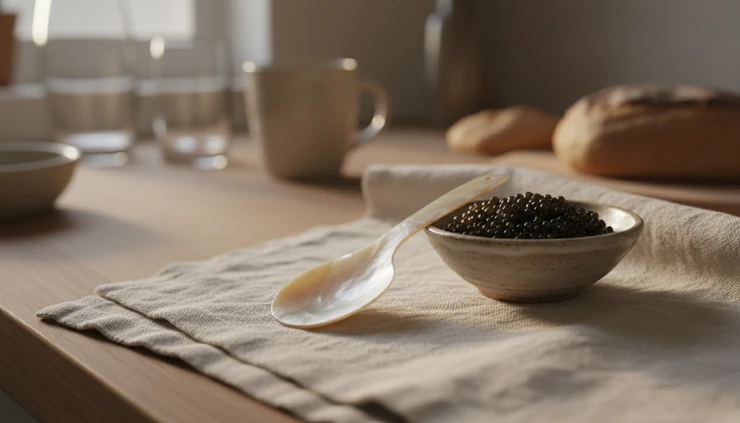
A mother-of-pearl spoon looks delicate, has a soft sheen and feels pleasantly cool. That is exactly why it often ends up in the drawer for special things: caviar, salt, honey, jam, mustard or small tasting portions. The mistake usually happens out of habit. After the meal, everything goes into the dishwasher, the beautiful spoon included.
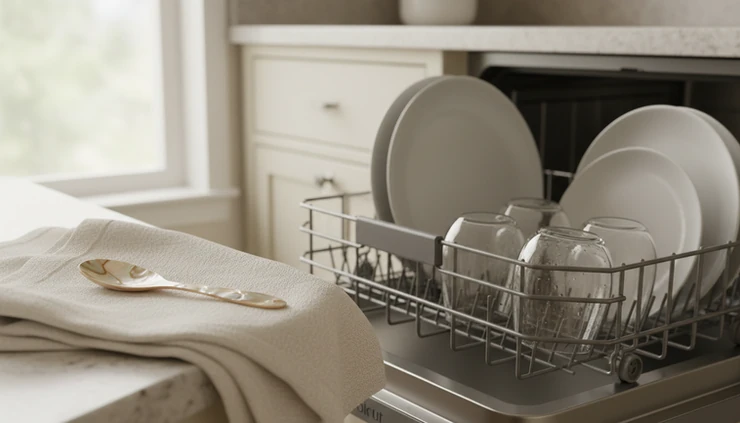
The short answer is: As a rule, a mother-of-pearl spoon is not dishwasher-safe. Mother of pearl is a natural material. It does not cope well with harsh detergents, high heat, prolonged moisture or sharp changes in temperature. What works perfectly well with stainless steel can make mother of pearl dull, stained or brittle.
If you want to keep the spoon beautiful for a long time, it is better to wash it by hand. That takes hardly any longer, but it protects the shine, surface and shape.
Why mother of pearl suffers in the dishwasher
Mother of pearl is neither plastic nor metal. It consists of fine layers that form inside shells. These layers contain mineral components and organic compounds. It is precisely this natural structure that creates the typical shimmer. But it also makes the material sensitive.
A dishwasher works under conditions that are unfavourable for mother of pearl:
hot water
alkaline detergents
salt and rinse aid
prolonged moisture
pressure from water jets
friction from cutlery and crockery
hot drying phases
Each of these points can cause small damage. Together, their effect is particularly strong. Often you cannot see it after a single wash. At first the spoon may look clean. After several cycles, however, it loses its silky shine. The surface becomes rougher, duller or develops pale spots.
Modern dishwasher tablets are especially critical. They are designed to dissolve grease, remove starch, attack tea and coffee stains and make glass sparkle. To do this, they contain substances intended for robust materials. For mother of pearl they are too harsh.
Heat also plays a big role. Changes in temperature can create tension in mother of pearl. If the spoon lies between heavy cutlery, it can also take pressure. Small cracks or chips then form more easily.
The safest rule is: anything made of mother of pearl, horn, bone, wood or similarly sensitive natural materials does not automatically belong in the dishwasher.
Another point is often overlooked: many mother-of-pearl spoons have edges, thin areas or finely ground handle ends. That is exactly where moisture can get in. If the spoon is also glued, set or combined with another material, the risk is even greater. Glued joints and settings can come loose through heat and moisture.
What can actually happen in the dishwasher
The most common damage is a dull haze. Mother of pearl lives from its play of light. If the surface is attacked, light no longer refracts as finely. The spoon then looks dull rather than shimmering.
Sometimes milky spots appear as well. They cannot simply be wiped off, because they do not sit on the surface like dirt. Often the top layer has already been attacked.
Another typical kind of damage is rough patches. If you run your finger over the spoon, it no longer feels smooth. That is a warning sign. A rough surface picks up discolouration faster and is harder to clean hygienically.
Thin spoons can even develop small cracks. At first these are barely visible. Over time they can grow, especially if the spoon is exposed to heat or moisture again.
Deformation is also possible. Mother of pearl is hard, but brittle. It does not give like silicone and is not as resilient as stainless steel. If a mother-of-pearl spoon gets jammed in the cutlery basket or heavy knives and forks knock against it, corners can chip off.
Dishwasher | Hand washing |
High temperatures attack the surface | Lukewarm water is gentle on the material |
Detergents and rinse aid can cause dullness | Mild washing-up liquid is usually enough |
Cutlery rubs and knocks together | The spoon stays safely in your hand |
Prolonged moisture can strain the edges | Drying immediately protects the shine |
Another kind of damage affects the colour. Mother of pearl can look slightly yellowish, greyish or blotchy if the surface has been attacked. This is particularly annoying with light, finely shimmering spoons, because every change is immediately noticeable.
What you must avoid with mother-of-pearl spoons
If a mother-of-pearl spoon is to stay beautiful, the dishwasher is not the only thing that matters. Some household remedies and everyday habits also harm the material.
Avoid harsh cleaners. Scouring cream, powder cleaners, oven cleaners, chlorine cleaners or strongly alkaline products are off limits. They attack the surface and can permanently destroy the shine.
Avoid scouring pads. The rough side of a kitchen sponge is too hard for mother of pearl. Even if the spoon seems sturdy, fine scratches appear. Often you only see them in the light.
Avoid long soaking. Brief contact with water is not a problem. Lying in the sink for hours is. Warm water with washing-up liquid over a longer period is particularly unfavourable.
Avoid acids. Vinegar, citric acid and descalers do not belong on mother of pearl. Many natural materials are sensitive to acid. Even if a treatment looks clean at first, the surface underneath can suffer.
Avoid hot water. Lukewarm is perfectly sufficient. Very hot water can encourage tension and strain glued joints.
Avoid direct heat. Mother-of-pearl spoons do not belong on the hob, next to open flames or near the rim of a hot pan. A very hot dish is not ideal either. Mother of pearl is much better suited to serving small cold or lukewarm portions.
Avoid scented oils and care oils unless necessary. Mother of pearl is not wood. Oil can leave streaks or residue. If a manufacturer recommends a special treatment, that is a different matter. Without a clear recommendation, it is better to stick to water, mild washing-up liquid and a soft cloth.
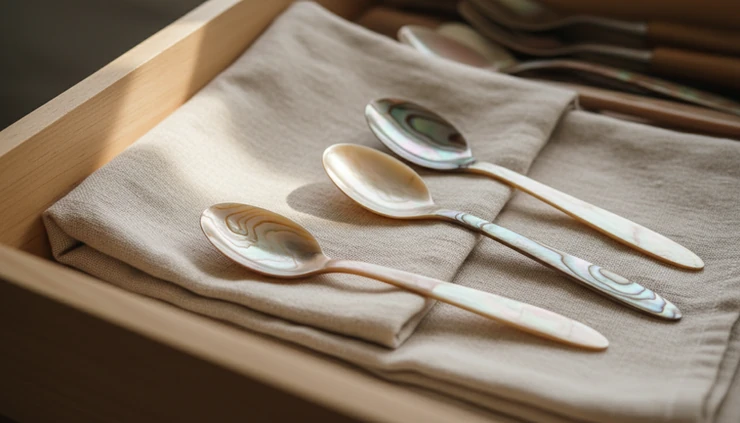
Avoid storing it loose with metal cutlery. If you just throw the spoon into the cutlery drawer, you risk scratches. Knives, forks and heavy spoons can damage the surface. A small fabric pouch, a cutlery tray with its own compartment or a soft base is better.
Be especially careful with antique mother-of-pearl spoons. In the past, handles, inlays or joints were sometimes made differently from today. Old glue, fine cracks or material fatigue make such pieces more sensitive. The rule here is: better too gentle than too thorough.
How to clean a mother-of-pearl spoon properly
The good news: a mother-of-pearl spoon is easy to clean if you do it straight after use. Usually only a few steps are needed.
First rinse the spoon under lukewarm water . Remove food remains with your fingers or a very soft sponge. If grease or sticky residue clings to it, add a drop of mild washing-up liquid.
Do not rub hard. Gentle movements are enough. Mother of pearl is smooth, so residue usually does not cling deeply. Then rinse off the washing-up liquid completely.
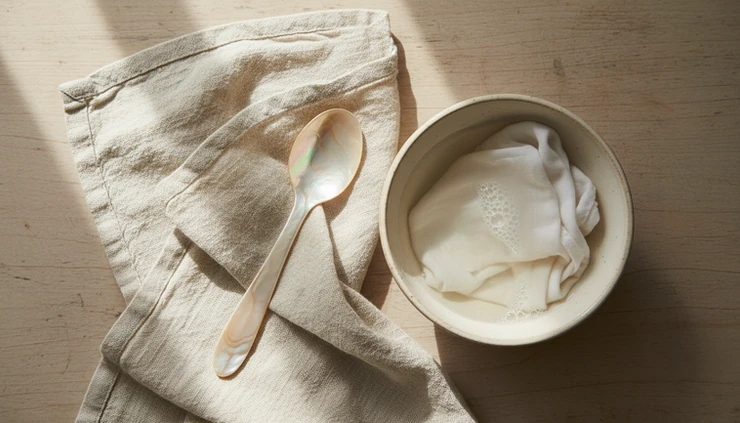
Dry the spoon immediately with a soft cotton or microfibre cloth. Do not leave it on the draining board. Moisture stays on the edges and undersides there. That is exactly what you want to avoid.
If the spoon was used for caviar, salt or strongly aromatic food, cleaning it quickly is especially sensible. Salt should not stay on the surface for long. Strongly coloured foods are also more likely to leave marks if they dry on.
A simple routine looks like this:
Rinse briefly in lukewarm water.
Use mild washing-up liquid if needed.
Clean gently with a soft cloth.
Rinse with clear water.
Dry completely straight away.
Store dry and protected.
A soft fabric pouch or a separate compartment is suitable for storage. If you own several mother-of-pearl spoons, do not let them rub directly against each other. A piece of soft cloth between the spoons is often enough.
If the spoon is rarely used, it is worth taking a quick look before using it next time. Does the surface feel smooth? Are there cracks, chips or dull patches? A damaged spoon should not be used for delicate foods where hygiene and surface matter most.
What to do if the mother-of-pearl spoon has already been in the dishwasher
A single wash does not automatically mean the spoon is ruined. What matters is what you do afterwards.
Take the spoon out of the machine and briefly rinse it with clear lukewarm water. This removes any residue of detergent, salt or rinse aid. Then dry it carefully straight away.
Check the surface in good light. Turn the spoon slowly back and forth. Look for dull patches, fine cracks, chips and rough areas. Carefully run your fingertip over it. If the surface feels smooth and shines normally, the spoon was probably lucky.
If the spoon has become dull, you should not experiment with home remedies. Toothpaste, bicarbonate of soda, vinegar or scouring powder can make the damage worse. Polishing with too much pressure is risky too. Mother of pearl does have a certain hardness, but a damaged surface is sensitive.
For a valuable piece, a specialist can help, for example someone from restoration, jewellery or high-end cutlery care. Not every kind of damage can be repaired invisibly. But an expert assessment is better than a spontaneous rescue attempt with kitchen products.
If glued joints have come loose or the spoon shows cracks, do not keep using it for food. Residue can collect in cracks. The piece can also break further. A damaged mother-of-pearl spoon can still be decorative, but should no longer serve as delicate serving cutlery.
Which foods and situations suit mother of pearl
Mother-of-pearl spoons are often recommended for caviar because they are taste-neutral and do not create the metallic impression some people notice with metal cutlery. They also go well with fine salts, small amounts of mustard, honey, jam or spice samples.
They are best suited to cold or lukewarm food. They are not meant for boiling-hot soups, pan dishes or stirring in a pot. Stainless steel, wood or heat-resistant plastics are there for that.
Restraint is also sensible with very acidic foods. Brief contact with a little lemon in a dish is not automatically a problem. Leaving the spoon in lemon juice, a vinegar marinade or an acidic sauce for a long time is not a good idea.
So mother of pearl is not an everyday spoon for everything. It is specialist cutlery for small amounts and special moments. That is exactly how it should be treated.
The simple rule of thumb for care
If you only want to remember one rule, make it this one: Treat mother of pearl briefly, mildly and dry. Clean briefly, use mild washing-up liquid and dry immediately.
The dishwasher is convenient, but too rough for mother of pearl. Heat, detergent, rinse aid and mechanical stress hit a material that lives from its fine surface. A few seconds of hand washing often protect the shine for years.
A mother-of-pearl spoon does not need complicated care. It just needs to be kept away from anything aggressive, hot or rough. Then it stays what makes it special: a small, beautiful piece of natural material for fine food and quiet moments at the table.
Find out more about our handmade Spoons Made of Genuine Mother of Pearl on our home page.