Serving Caviar at Home Like a Fine-Dining Restaurant: The Right Equipment

Caviar forgives very little. It needs no grand show, but it is sensitive to warmth, the wrong cutlery and too many accompaniments. If you want to serve it at home the way a Michelin-starred restaurant would, you need one thing above all: the right equipment at the right time.
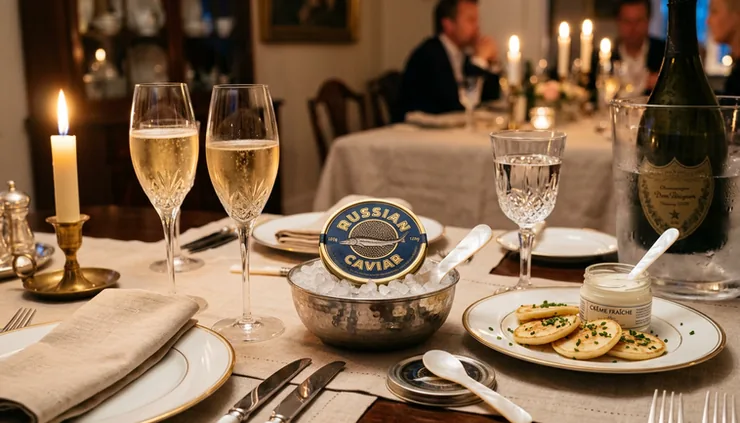
The good impression does not begin with the first taste. It begins when the tin is opened, with the cool shine on the ice, the right spoon and the question of whether blinis, crème fraîche and champagne accompany the caviar or drown it out. This is exactly where an elegant moment of indulgence parts ways with an expensive disappointment.
This guide offers a practical ranking of the most important utensils. The point is not to buy as much as possible. The point is to know the things that protect the flavour and make serving look clean, calm and refined.
Why the equipment matters so much with caviar
Caviar is not a snack you take out of the fridge and put on the table. The delicate roe depends on temperature, texture and a clear, clean flavour. Even small mistakes can change the impression.
Serving it too warm makes caviar softer and less fresh on the palate. An unsuitable spoon can emphasise a metallic note. Accompaniments that are too strong steal the stage from the caviar. And an open tin left unchilled for too long quickly loses its elegance.
That is why restaurants often serve caviar in a very pared-back way. There is a reason for this. A few well-chosen elements show off the quality better than a table full of distractions.
The same rule applies at home: cold, neutrality, clean serving and a calm set-up. Your equipment should support exactly these four points.
The ranking of the most important equipment
The following ranking rates the equipment by its influence on flavour, temperature, presentation and practical handling. Number 1 is the most important. If you only want to buy a few things, start at the top.
Rank | Equipment | Why it matters | Recommendation for home |
1 | Mother-of-pearl spoon or horn spoon | Protects the pure flavour and looks stylish | Have at least two small spoons ready |
2 | Caviar bowl on ice | Keeps the tin cold without watering down the caviar | Use a small glass bowl, silver bowl or serving bowl with ice |
3 | Chilled serving plates | Prevent quick warming at the table | Put the plates in the cold shortly before serving |
4 | Suitable accompaniments | Support the caviar instead of masking it | Use blinis, buttered toast, crème fraîche, egg and chives sparingly |
5 | Precise tin opener or caviar key | Opens the tin cleanly without pressing on the eggs | Test it beforehand rather than struggling at the table |
6 | Small portioning aid | Makes even portions easier | Small spoon or spatula made of mother of pearl, horn or glass |
7 | Matching drinks | Lengthen the flavour and cleanse the palate | Champagne, dry sparkling wine, very dry white wine or ice-cold vodka |
8 | Serving cutlery for accompaniments | Prevents chaos and mixing | Use separate small cutlery for each accompaniment |
9 | Linen napkins and simple tableware | Elevate the overall impression | White, glass, silver or dark ceramics look especially calm |
10 | Kitchen scales for portions | Help with planning and cost control | For several guests, portion in advance or calculate quantities clearly |
Number 1 wins because the spoon has direct contact
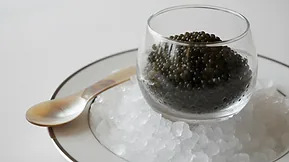
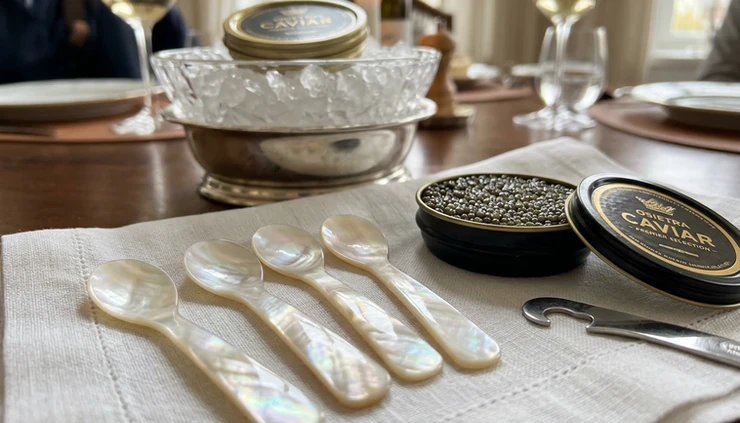
The spoon is the smallest utensil on the list, but it has the biggest effect. Traditionally, mother of pearl is used. Horn, bone, glass or porcelain also work well. Many hosts avoid metal because it can disturb the delicate flavour. Whether every person perceives this difference equally strongly is secondary. With caviar, what counts is treating the product with respect.
A mother-of-pearl spoon also instantly looks like caviar service. It signals that this moment was planned with care. For a dinner, two to four spoons are usually enough.
Large tablespoons are not ideal, nor are strong-smelling wooden spoons or cutlery that comes straight out of the dishwasher and is still warm.
Number 2 goes to the bowl on ice
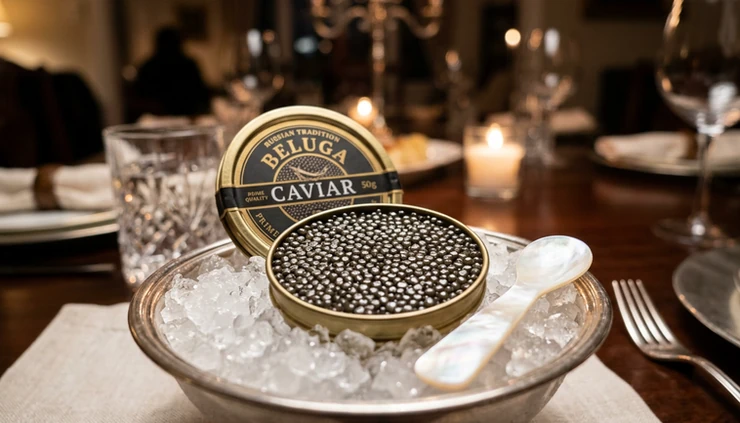
Caviar should stay cold while it is served. A bowl of crushed ice or ice cubes is the simplest solution. The tin sits on top, or in a small bowl resting in the ice. It is important that no meltwater gets into the caviar.
Do not place the tin directly into a deep mix of water and ice if it wobbles or could sink. A stable set-up is better:
A wider bowl as the base
Crushed ice or small ice cubes
A smaller bowl or the caviar tin as the insert
A small cloth underneath if anything might slip
That way everything stays under control and looks well kept.
How to make your caviar service truly feel like a fine-dining restaurant
The best equipment only helps if the sequence is right. Good caviar service is calm, precise and prepared. Nobody should be searching for ice, opening packaging or hastily cutting accompaniments at the table.
Preparation starts in the fridge
Caviar stays in the fridge until shortly before serving. The coldest part is ideal, but not the freezer. The tin should stay closed until everything else is ready.
About 10 to 15 minutes before serving, you can put the plates or small bowls in the cold. The drinks should also go into the fridge in good time. With champagne or sparkling wine, being well chilled matters more than a dramatic presentation in an ice bucket.
Shortly before serving, arrange the bed of ice, set out the accompaniments and open the tin. Only then does the caviar come to the table.
The caviar should be the centrepiece. Everything else is accompaniment, not decoration.
Accompaniments should stay quiet
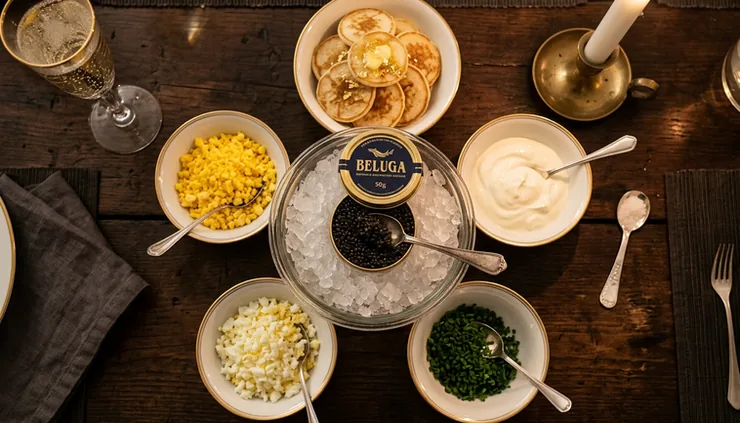
Classic accompaniments have their place, but they should be mild and finely portioned. Small blinis, thinly sliced toast, crème fraîche, very finely chopped egg white and yolk, and chives are particularly suitable.
Onions are controversial. They suit some more rustic styles of serving, but can be too dominant with fine caviar. If you offer onion, cut it very finely and serve it separately. That way everyone can decide for themselves.
Good companions are:
Blinis
Mild, soft and classic. They should be warm, but not hot.
Toast
Thin, light and lightly buttered. Too dark a roast can interfere.
Crème fraîche
Cool and creamy. A small amount is enough.
Chopped egg
Serve separately so the caviar is not overpowered.
Chives
Cut very finely and use sparingly.
If you want to taste caviar pure, start without any accompaniment. A small spoonful placed directly on the hand between thumb and index finger is a traditional method at tastings. At home, the mother-of-pearl spoon is usually more elegant and practical.
The right order at the table
Caviar service works best as a small routine. It does not have to feel stiff, but it needs structure.
Pour or set out the drinks.
Bring plates and accompaniments to the table.
Take the caviar tin out of the fridge.
Open the tin cleanly.
Place the tin on ice.
Briefly offer the caviar on its own.
Then add the accompaniments.
This order prevents the caviar from getting unnecessarily warm. It also makes sure that the first taste belongs to the product itself. This is especially useful if you are comparing different varieties, such as a mild Ossetra style, a more robust Sevruga character or particularly large, light-coloured eggs.
When portioning: smaller amounts look more refined and are easier to enjoy. A heaped spoonful looks generous, but sometimes takes away the caviar's finesse. Better to top up than to overload at the start.
Avoiding common equipment mistakes
Many mistakes come from good intentions. You want to present the caviar beautifully and overfill the plate. Or you use the finest cutlery in the house, even though it is not the best choice for flavour.
Too much metal in the wrong place
Silver bowls, stainless steel cutlery and metal trays can look beautiful. But direct contact with the caviar should be as neutral as possible. The tin itself is of course made of metal, but non-metallic cutlery is recommended for taking and eating the caviar.
If you only have stainless steel cutlery, it is not a disaster. The enjoyment is not ruined. For a restaurant-style impression, a small set of mother-of-pearl spoons is still worth it.
The tin stays open for too long
An opened tin should not stay unchilled on the table for long. Plan small, quick portions instead. If caviar is left over, cover it cleanly and put it back in the cold. Leftover caviar should be eaten soon.
Avoid going into the tin with cutlery that has already been used. That is not only unappetising, it can also affect freshness.
The accompaniments are too aromatic
Garlic, strong herbs, lemon juice, spicy sauces or heavily salted crackers rarely suit high-quality caviar. They mask exactly what you are paying for: fine saltiness, delicate nuttiness, creamy texture and the clear taste of the sea.
If you want to experiment, do it with small amounts. The main service should stay classic.
The presentation looks overloaded
Fine dining does not automatically mean opulence. Often it is precisely restraint that feels luxurious. A simple bowl, good ice, a beautiful spoon and a few accompaniments are enough.
Leave some empty space on the table. Not every centimetre needs to be filled. White porcelain, clear glass and soft light make caviar look more refined than garish plates or too much decoration.
Buying equipment or working with what you have
Not every kitchen needs a complete caviar set. If you only serve caviar occasionally, a few targeted purchases will do. What matters is what comes into direct contact with the product and what keeps the temperature.
Priority | If you want to buy little | If you serve more often |
High | Mother-of-pearl spoons, small glass bowl, ice | Caviar set with insert bowl and several spoons |
Medium | Small bowls for accompaniments, chilled plates | Matching porcelain, small serving platters |
Low | Linen napkins, simple glasses | Champagne cooler, high-quality trays, special portioners |
For a first successful service, these things are often enough:
1 small bowl for ice
1 bowl or the original tin as the insert
2 mother-of-pearl spoons
4 small dishes for accompaniments
Chilled plates
A clean cloth for condensation
The result can already look very refined. Caviar does not demand a lot of gear. It demands attention.
The final touch for the perfect moment
Shortly before serving, it pays to look at the details. Is the ice fresh and clean? Are the spoons free of water spots? Are the accompaniments not too close to the caviar tin? Are the glasses cold enough?
Light plays a role too. Soft, warm light makes the surface of the caviar shine. Kitchen lighting that is too bright quickly looks harsh. Candles or a small table lamp can improve the impression considerably without looking artificial.
The drink does not have to be champagne. A good dry German sparkling wine can be an excellent match. Very dry white wine or classic ice-cold vodka also work, as long as they cleanse the palate and do not taste sweet.
What matters is balance. After the first spoonful, the caviar should make you want a second.
The best equipment is simple and well thought out
If you want to serve caviar at home like a Michelin-starred restaurant, you do not need an exaggerated production. The most important things are a neutral spoon, reliable cooling, small chilled plates and mild accompaniments. After that, order, calm and timing count.
The ranking shows clearly: mother-of-pearl spoons and serving on ice come out on top, because they protect the flavour directly. Everything else improves the flow and the effect at the table.
Buy a few good basics first, practise the set-up once before the dinner and keep the presentation simple. Then a small tin of caviar becomes a moment that feels truly special.
Find out more about our handmade Spoons Made of Genuine Mother of Pearl on our home page.